

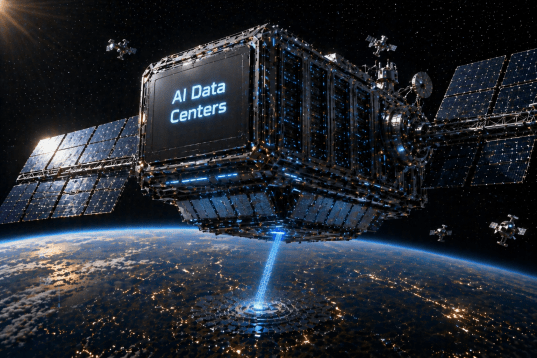
Kathmandu: The race to build computers in space has officially begun. Space-based AI data centers, satellites carrying powerful chips that run artificial intelligence workloads, are no longer just a concept. Companies across the United States and beyond are already launching hardware, raising billions, and filing plans with regulators to make this a real industry.
In November 2025, a startup called Starcloud launched the world’s first satellite carrying an NVIDIA H100 GPU, the same chip used in the most powerful AI systems on Earth today. By March 2026, Starcloud had raised $170 million to build more. Its next satellite, Starcloud-2, will carry 100 times more solar power and the largest deployable radiator ever built in space. Meanwhile, SpaceX filed plans with the FCC in February 2026 for a network of up to one million satellites dedicated to AI computing in orbit. Meta announced a deal with space energy company Overview in April 2026 to purchase up to one gigawatt of power from future space-based solar systems.
The reason space-based AI data centers are attracting so much attention comes down to two simple advantages: unlimited solar energy and free cooling. In space, satellites can access sunlight nearly 24 hours a day without clouds or nighttime blocking them. Heat from computers can also be released directly into the cold vacuum of space through radiator panels, with no water or cooling equipment needed. These two factors could make running AI in orbit far cheaper than on the ground, once rocket launch costs fall low enough.
However, space-based AI data centers still face serious challenges. Launch costs remain high, and getting enough hardware into orbit is expensive. Sending power back to Earth through microwave or laser beams loses a large portion of energy along the way. Space debris from thousands of new satellites is also a growing concern for regulators worldwide.
Google, Amazon, and NASA are all watching closely. Most experts agree that this technology is still in early testing, with large-scale commercial operations likely not arriving before the mid-2030s.








Leave a Reply